Day 5
After a restful night, we set out once again toward the C&O Canal. A bit of backstory: the idea for the C&O Canal had been in the works since the late 1700s, with incremental construction stretching to Cumberland. By the time the canal was operational in 1850, the railroads were already taking root in Cumberland, and trains were improving year by year.
The C&O Canal thrived until the 1920s, when it fell into disrepair and was largely abandoned. It wasn’t until some forward-thinking members of Congress decided to transform it into a national park that it began to regain significance. Years later, a similar revival occurred with the Great Allegheny Passage (GAP), and together, the GAP and C&O Canal trail as we know them today were born.

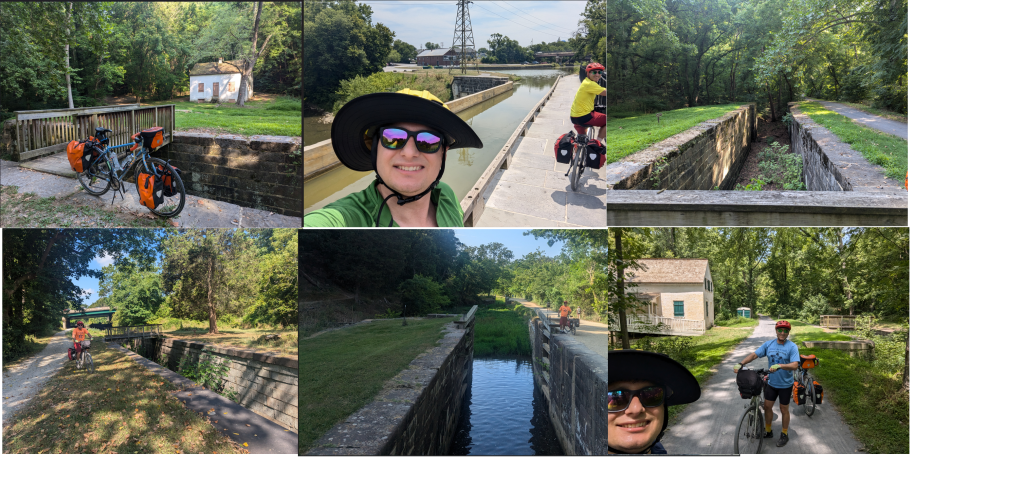
As we rode along, we passed numerous locks in various states of preservation—some fully restored and operational, while others lay buried, with only their stone remnants visible. The bridges we encountered were particularly fascinating; they often maintained water levels for boats, sometimes spanning over rivers.
Eventually, we reached the only restaurant in what felt like a 30- to 40-mile stretch: Bill’s Place, a welcoming biker bar that embraced anyone on two wheels. It also served as the town hall and grocery store for Little Orleans, a quaint town with a population of just a few hundred.
We ordered a couple of cod sandwiches and then continued our journey on the Maryland Rail Trail, which was paved and offered a welcome respite from the poison ivy. Along the way, we explored abandoned telegraph lines, some still waiting to carry their next messages.
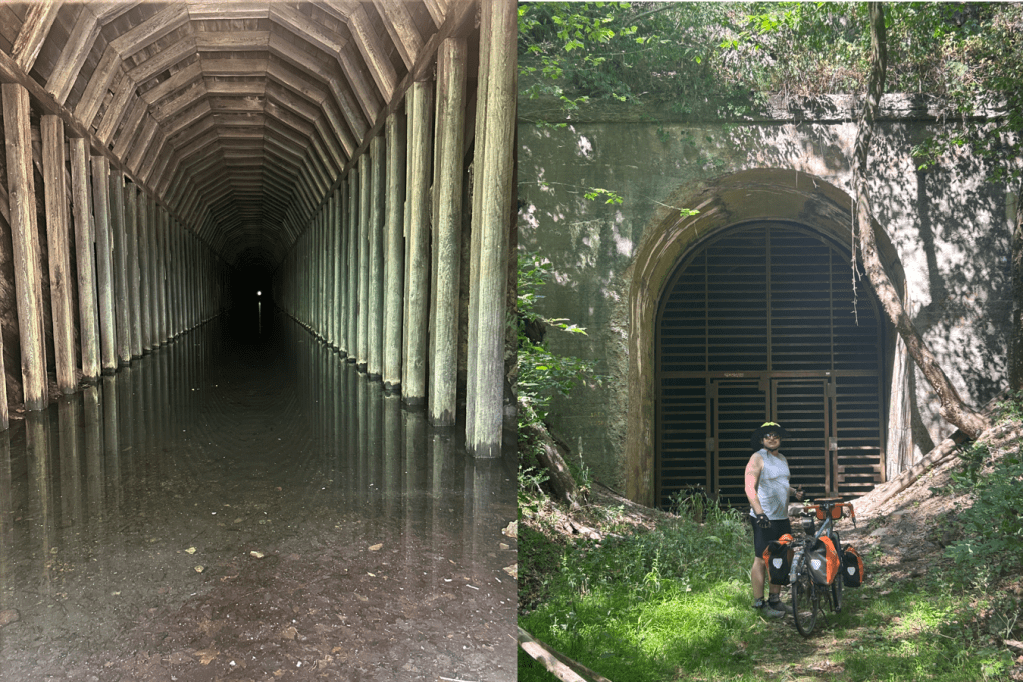
The trail promised an intriguing destination: the Indigo Tunnel. As we approached, a chill from the tunnel’s depths greeted us, a ghostly reminder of the past. Vines clung to the tunnel’s entrance, framing a well-crafted concrete arch. However, our entry was blocked by thick steel bars.
A soft glow emanated from the far end of the tunnel, and when we shone our flashlight, we revealed wooden beams, each a foot and a half thick, lining the walls and spaced every four feet, all sitting in a few inches of stagnant water. The cool breeze flowing from the tunnel offered a refreshing escape from the heat.
We poked and prodded, imagining a day when this tunnel might be integrated into the trail network, though for now, the ghosts of the past would have to wait for the day a bike path could run through their hallowed space.
We pressed on, riding the Maryland Rail Trail until we stumbled upon an abandoned bike trailer just outside Hancock. It was a sight that tested my tolerance for litter. We stopped to brainstorm how we could haul it away. After some tinkering, we managed to establish a solid connection between the trailer and my bike. With that, we set off to clear the trail by dragging the decrepit trailer behind us. Then came the moment of truth: the roll test.
“Roll test!” I declared.
“3…2…1…” Stephen counted down.
We matched our bikes’ speed and position, then coasted, letting momentum take over as we gauged who would pull ahead. My Masi bike, a sturdy chromoly steel frame with thick tires and full fenders, usually had the advantage over Stephen’s lightweight aluminum ride. But today, while towing a trailer with two flat tires, Stephen’s bike somehow eked out a draw. This would surely haunt him—my bike would always be faster.
It must be the tires.
Rolling into Hancock, we decided to abandon the trailer at a local bike shop, though I wasn’t thrilled with the plan; I would’ve preferred to find an unguarded dumpster instead.
We then arrived at our hotel, a notable spot in Hancock with a solid 3.5-star rating on Google. The cashier at the local package store had good things to say: “Oh, it’s better than the Super 8—that place is a meth house!”
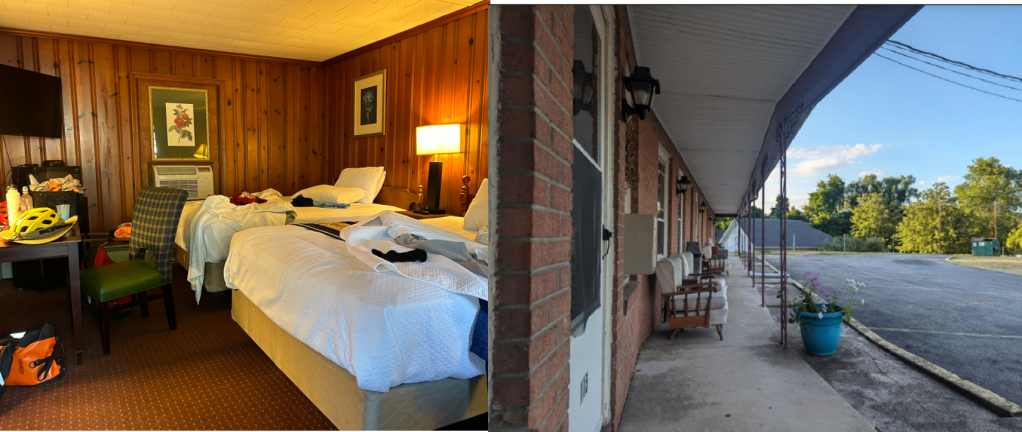
The hotel was a refreshing sight, with furniture that had clearly seen years of use. The room felt like a time capsule; the bathroom, built to last, had survived since the ’80s. This prompted a solid thirty minutes of playful banter about our wives.
Vincent joked, “Oh, Rebecca would never stand for this hotel. Just look at the pre-stained sheets!”
Stephen replied, “If my wife were here, this trip would be over. It smells musty!”
“What’s musty supposed to mean?” I asked.
“Musty means the room costs less than $250 per square foot, according to Zillow!”
We headed to the finest restaurant in town—well, technically the only one open—and were seated by the window. The burger was fantastic.
The next morning, we set off for Harper’s Ferry, but first we needed breakfast. Our only option was Subway. After fueling up, we hit the trail, gearing up for our longest day of riding—64 miles—in the sweltering heat.
This stretch of the journey was one of the prettiest. To our right, the Potomac River stretched wide, its surface dotted with rocks and reeds that seemed to battle for space in the water.
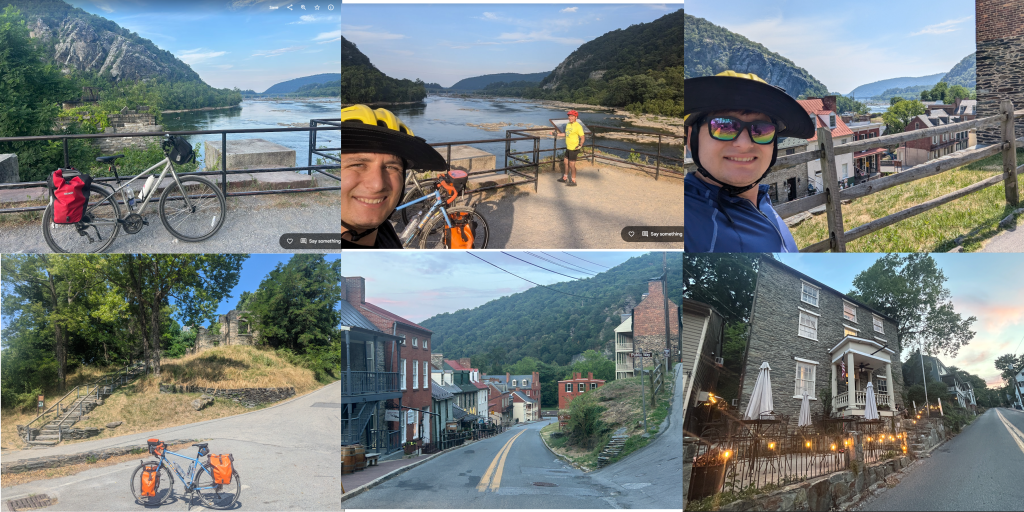
Finally, we arrived in Harpers Ferry, a city woven among the remnants of history. A network of bridges and the ruins of past structures welcomed us as we entered via a bridge accessible only by stairs. At the landing, we were greeted by the foundations of former forts and buildings, all made of brick and stone, each telling a story of resilience.
Despite its storied past, the town has thrived, transforming from an industrial hub into a vibrant tourist destination for Appalachian Trail hikers and C&O Canal riders. We meandered through the streets like a ball in a pinball machine until we finally located our historic hotel, perched on a hill in front of a dramatic cliff. The narrow stone alley was a tight squeeze for our bikes but opened into a charming courtyard.
Wandering around, we stumbled upon the front desk—or was it a kitchen counter? The space was a multifunctional room that served as a hotel desk, a camping gear shop, and a self-service kitchen all in one. We were warmly greeted by a lovely lady, and after discussing our reservation, we found our room and took turns showering to wash off the remnants of a sweltering 103-degree day. As the temperature dropped, we set out for burgers with a view.
Next, we rode to Lock 21.
The ride was a bit long, but we passed several wells near campsites, which we used liberally to cool off. Eventually, we settled down to finish the leftover food from our earlier meal. After a while, we met a man in a disheveled collared shirt, and through conversation, we learned he had fascinating stories about dog sledding tours in far-off places. Though he was born just up the road in Harpers Ferry, he now lives in Switzerland. He was hiking the C&O Canal—an interesting choice for transportation. He works for the World Bank, traveling frequently for audits and checks.
As we continued, the trail opened up to a concrete path flanked by cliffs on one side and the Potomac shimmering in the sunlight on the other. We pressed forward, the only direction to go, traveling several miles along this beautiful route.
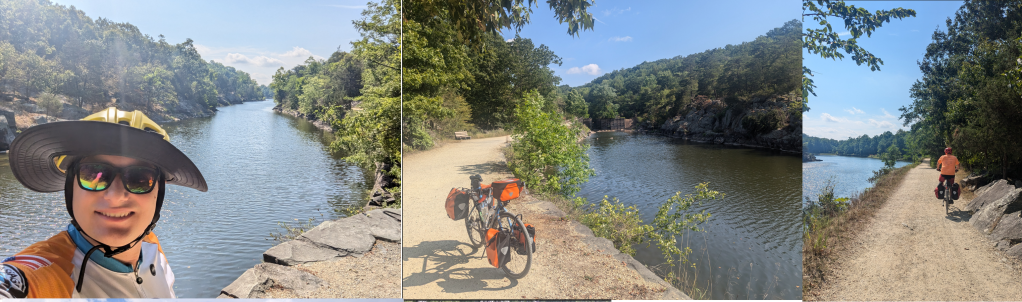
Many of the locks along the canal were accompanied by lock houses, providing homes for the lock workers and their families, often in remote locations. This arrangement was a good deal; many workers passed the job down through generations. With a lock every 1 to 2 miles, all numbered for easy navigation, it was simple to gauge how much farther we had to go.
Eventually, we reached Lock 21. What makes this lock special is that Stephen and I are renting the historic lock house for our stay. We get to experience life as if it were 1920—well, almost; the place comes with air conditioning, electricity, and modern lighting. Sure, the lock house has seen some renovations, but we embraced the spirit of the past. Our dinner that evening was a true nod to the era: mac and cheese mixed with tuna. Surprisingly, it tasted wonderful. I’m starting to think these bike tours are skewing my sense of taste.
The Next day
Was a short ride to Washington DC it was only 20 miles I believe.
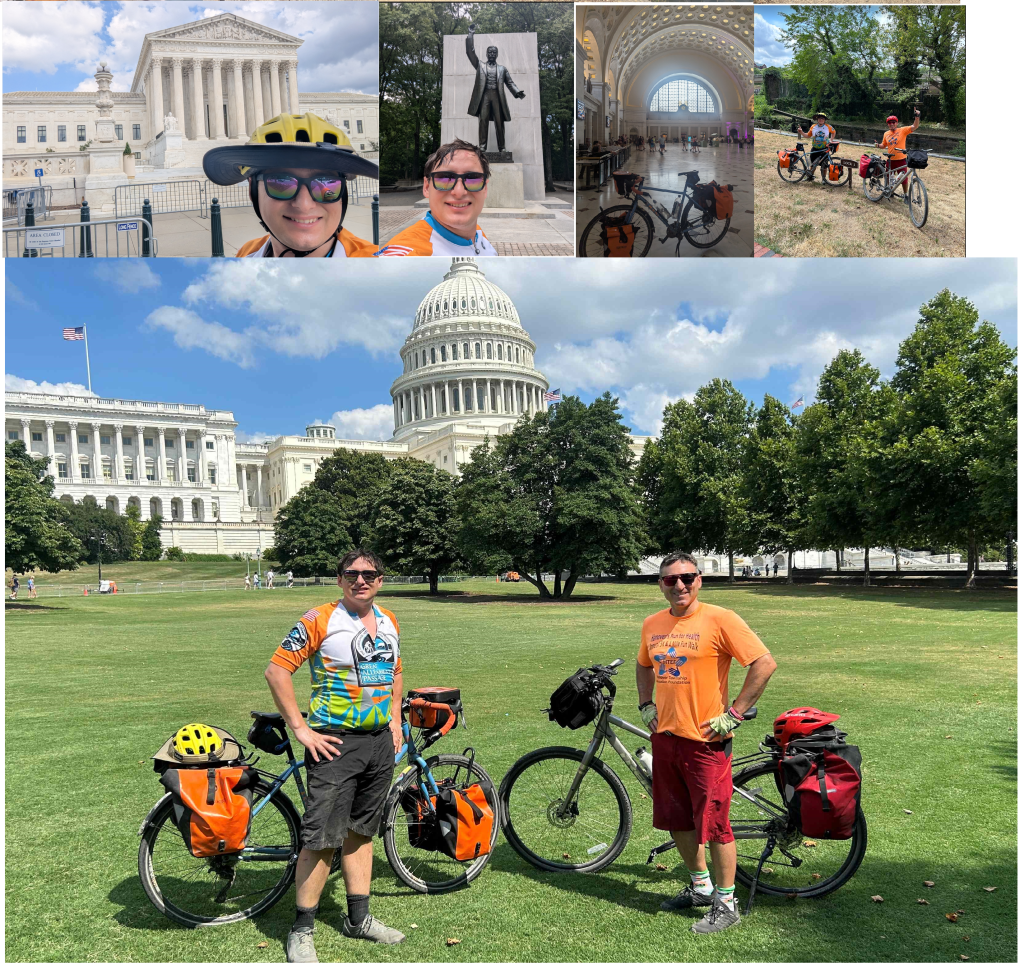
We found our way to the train station, found some food and boarded the train set for New Jersey and Hartford. Another bike tour completed.
The Stats:
Mechanical failures: A bike mirror broke off of Stevens bike.. That’s it
Pounds lost: Gained two pounds
Average speed: Probably 10 to 11 mph
Max speed: 30 mph
Most Repeated sentence: “We’re Doing it!!”
Most liked item other than the bike: Da-brim and sunglasses
Most useless Item: A beach towel
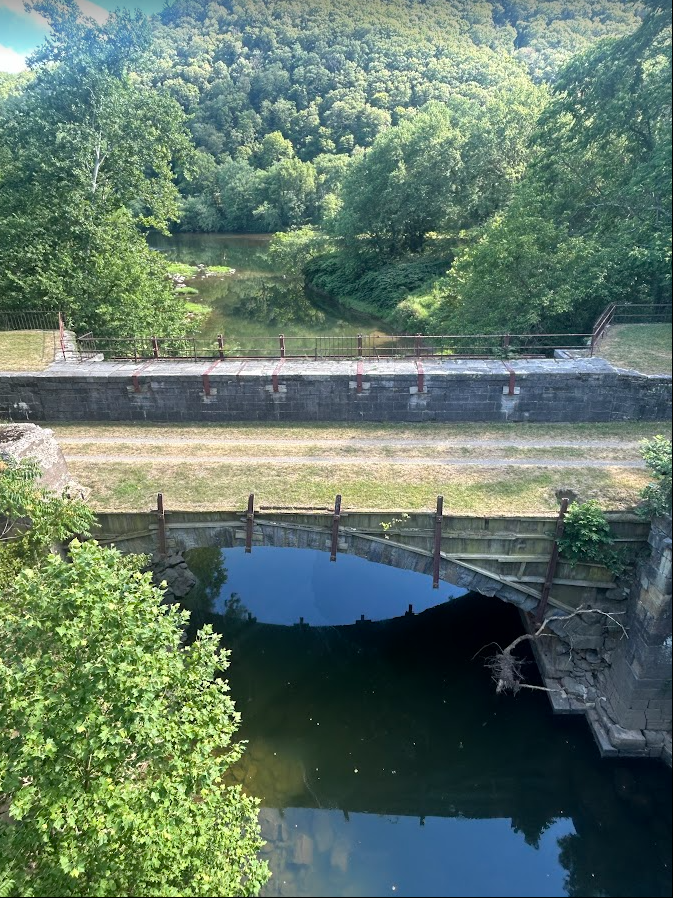
Picture of a canal bridge the bridge used to be full of water. Its now missing a large portion
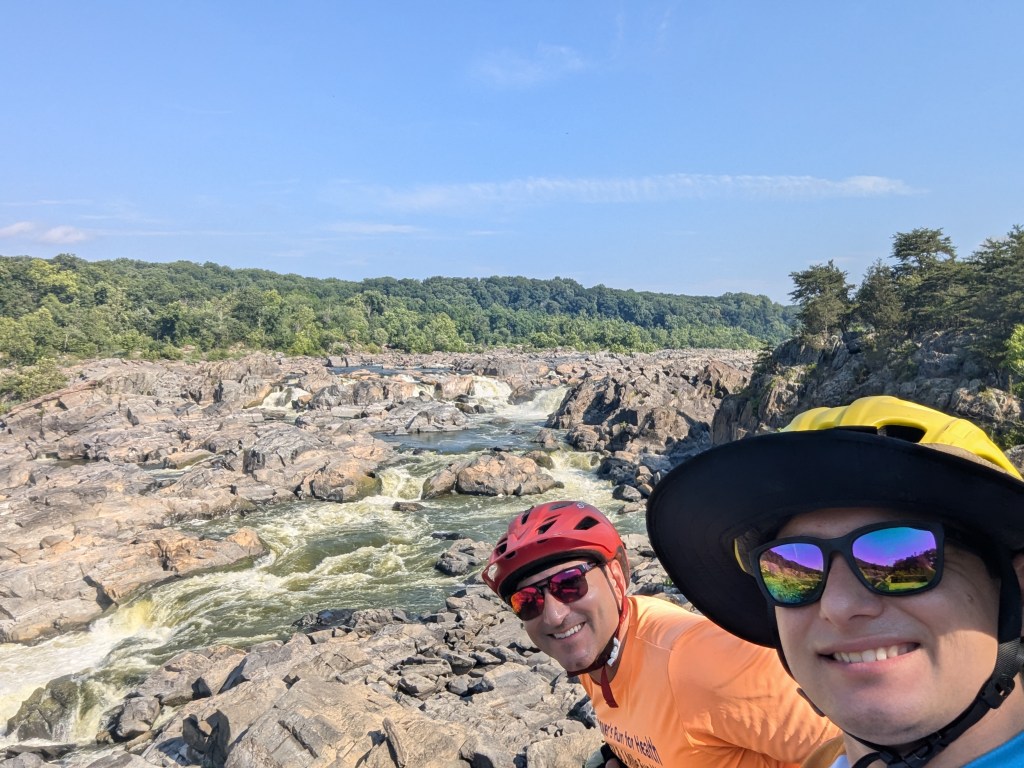
A nice picture I wanted to share
 ChiricoChronicles